
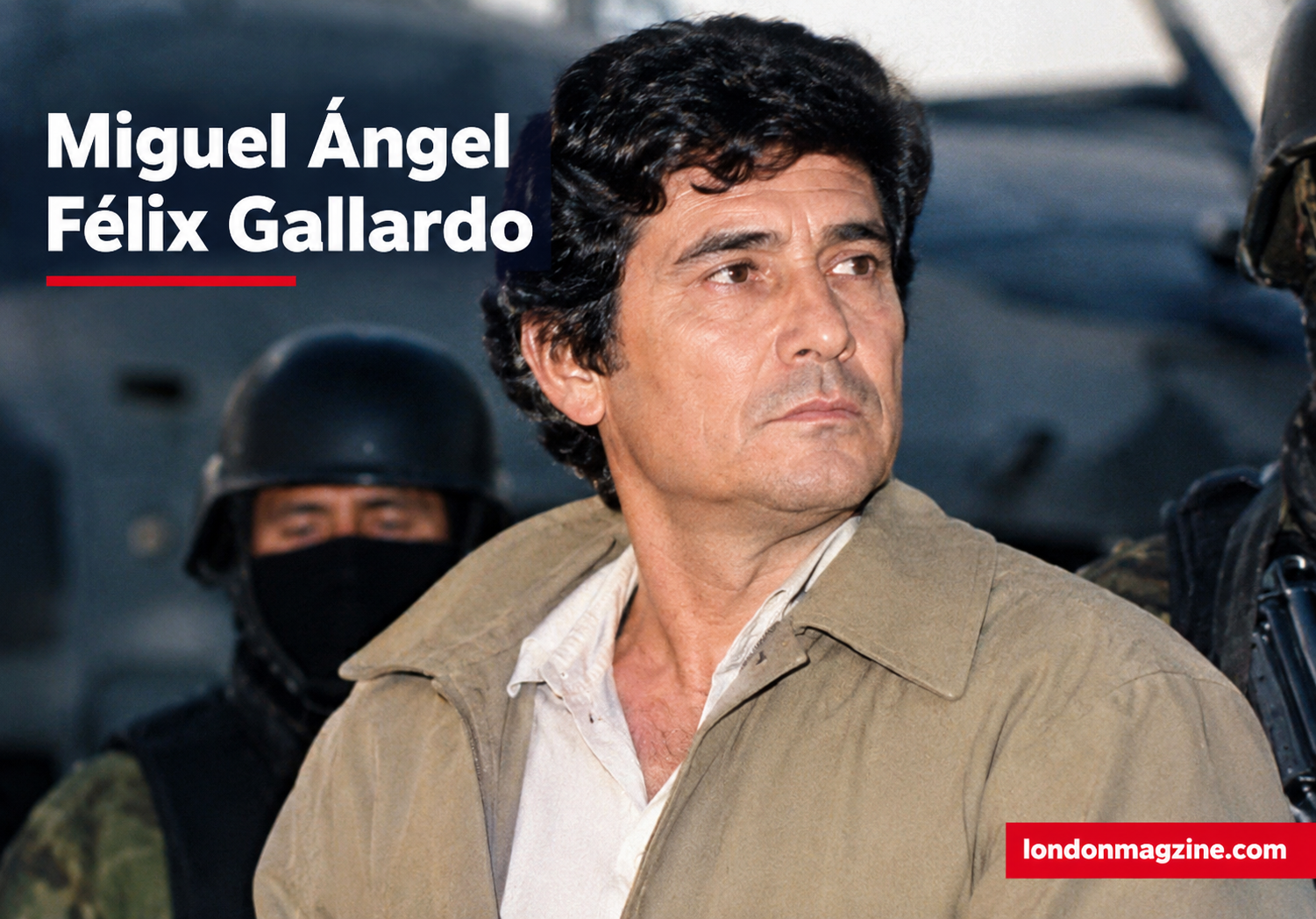
Miguel Ángel Félix Gallardo is one of the most recognizable names in the history of organized crime in Mexico. Known by nicknames including “El Padrino” and “El Jefe de Jefes,” he became a central figure in the Guadalajara Cartel during the 1980s. His story is closely connected to the transformation of Mexico’s drug-trafficking networks, the murder of DEA agent Enrique “Kiki” Camarena, and the fragmentation of the Guadalajara organization into groups that later became major cartels.
Who Was Miguel Ángel Félix Gallardo?
Miguel Ángel Félix Gallardo is a Mexican former drug trafficker who became one of the most influential figures in Mexico’s narcotics trade during the 1980s.
Born in 1946 in the Culiacán area of Sinaloa, he initially worked in law enforcement before entering organized crime. His background in policing and his connections with influential figures helped him develop relationships that became important to his criminal organization.
Félix Gallardo later became associated with Rafael Caro Quintero and Ernesto Fonseca Carrillo, helping establish the Guadalajara Cartel. During its peak, the organization played an important role in moving marijuana and other drugs through Mexico toward the United States.
The U.S. Drug Enforcement Administration has described the Guadalajara organization as a major force in the development of Mexican drug trafficking during this period.
The Story Behind Miguel Ángel Félix Gallardo
The story of Félix Gallardo is not simply about one criminal organization. It is also about a period when Mexico’s trafficking networks were becoming increasingly sophisticated and internationally connected.
Early Life and Background
Félix Gallardo was born on January 8, 1946, near Culiacán, Sinaloa. Public biographical accounts identify his early employment as a police officer with the Mexican Federal Judicial Police.
His law-enforcement background gave him familiarity with government structures and reportedly helped him develop valuable contacts. He eventually moved away from legitimate employment and became involved in the drug trade.
By the 1970s and early 1980s, Félix Gallardo had become an important trafficker. His activities expanded as Mexican organizations increasingly became transportation partners for Colombian cocaine producers seeking routes into the United States.
Building the Guadalajara Cartel
The Guadalajara Cartel emerged as one of Mexico’s most important trafficking organizations during the 1980s. Félix Gallardo operated alongside figures such as Rafael Caro Quintero and Ernesto Fonseca Carrillo.
The organization became particularly important because Mexico was geographically positioned between South American cocaine producers and the lucrative U.S. market.
DEA historical records describe how Colombian organizations increasingly partnered with Mexico-based traffickers as American enforcement disrupted older Caribbean and Florida trafficking routes.
This changing geography helped transform Mexican traffickers from regional smugglers into major international players.
Key Events That Changed His Life
The most consequential chapter in Félix Gallardo’s history involved DEA Special Agent Enrique “Kiki” Camarena.
Camarena was investigating drug trafficking operations in Mexico when he was abducted in Guadalajara on February 7, 1985. DEA records state that he was subsequently tortured and killed. The murder triggered Operation Leyenda, a major DEA investigation that pursued those believed responsible.
The case generated enormous pressure on Mexican authorities and became one of the defining law-enforcement confrontations of the era.
Félix Gallardo remained free for several years after other major Guadalajara figures were arrested. He was eventually arrested in Guadalajara on April 8, 1989. Contemporary reporting described him as a major target of U.S. narcotics authorities.
Arrest and Conviction
Félix Gallardo was imprisoned in Mexico from 1989 onward.
His legal case became unusually prolonged. A 2017 Mexican court decision resulted in a 37-year sentence connected to the killing of Camarena and Mexican pilot Alfredo Zavala, along with a substantial reparations order.
It is important to distinguish between the various sentences and legal proceedings surrounding his imprisonment. Reports have sometimes summarized his punishment differently depending on which conviction or sentence is being discussed.
What Happened to the Guadalajara Cartel?
One of the most important parts of Miguel Ángel Félix Gallardo’s legacy is what happened after his arrest.
The Guadalajara Cartel did not simply disappear overnight. Instead, its network fragmented as different trafficking leaders gained control over separate territories and routes.
DEA historical material states that the Arellano-Félix family inherited the Tijuana organization after Félix Gallardo’s arrest in 1989. Other networks developed around different regions and trafficking corridors.
This fragmentation became significant because several later Mexican trafficking organizations can be historically connected, directly or indirectly, to the people and networks that emerged from the Guadalajara era.
The Connection to Later Cartels
Félix Gallardo’s name is frequently mentioned in histories of the Sinaloa and Tijuana trafficking organizations.
DEA historical material also describes Joaquín “El Chapo” Guzmán as having been introduced to Félix Gallardo during the early 1980s and later becoming involved in logistics for the organization.
However, describing every later cartel as simply being “created by” Félix Gallardo would oversimplify a complicated history. Different organizations developed through changing alliances, territorial disputes, arrests, deaths and internal divisions over many years.
Why Is Miguel Ángel Félix Gallardo Still So Well Known?
Interest in Miguel Ángel Félix Gallardo has remained strong for several reasons.
First, his career occurred during a pivotal period in the development of Mexican organized crime. Second, his name became permanently connected to the Camarena investigation, one of the DEA’s most significant international investigations.
His story has also been explored in documentaries, books and fictionalized television productions, including Narcos: Mexico. These portrayals introduced his name to audiences who may know little about the historical events behind the character.
Popular entertainment, however, should not automatically be treated as a historical record. Dramatic productions may combine documented events with reconstructed conversations, fictional scenes or compressed timelines.
The Human Cost Behind the Criminal Empire
The history surrounding Félix Gallardo is sometimes presented through the language of power, money and territory. That framing can obscure the human consequences of the trafficking system.
The Camarena case alone illustrates how violent the conflict became. DEA records describe Camarena’s abduction, torture and murder and the enormous investigative response that followed.
The broader Guadalajara Cartel era also contributed to an environment in which trafficking organizations, corrupt officials and violent enforcement became increasingly intertwined.
Understanding that context is important when examining Félix Gallardo’s historical significance. His story is not merely the biography of a famous trafficker; it is also part of the development of a criminal economy whose consequences extended across Mexico and the United States.
Miguel Ángel Félix Gallardo: Facts at a Glance
| Category | Details |
|---|---|
| Full name | Miguel Ángel Félix Gallardo |
| Born | January 8, 1946 |
| Birthplace | Culiacán area, Sinaloa, Mexico |
| Known for | Guadalajara Cartel |
| Nicknames | “El Padrino,” “El Jefe de Jefes” |
| Major associates | Rafael Caro Quintero, Ernesto Fonseca Carrillo |
| Arrest | April 1989 |
| Major case | Enrique “Kiki” Camarena murder case |
| Major sentence | 37-year sentence reported in 2017 |
| Later status | Granted house arrest in 2022 amid health concerns |
What Happened to Him After Decades in Prison?
After more than three decades behind bars, Félix Gallardo’s deteriorating health became an important part of his legal situation.
In September 2022, a Mexican judge granted him house arrest after he had spent approximately 33 years in prison. Reuters reported that the decision was connected to his age and health, while prosecutors challenged the move.
Contemporary reporting also noted serious health problems, including significant hearing and vision impairment.
Because later public reporting does not consistently establish every detail of his current legal status, claims about his precise living arrangements or present activities should be treated cautiously rather than repeated as established fact.
Frequently Asked Questions
Who is Miguel Ángel Félix Gallardo?
Miguel Ángel Félix Gallardo is a Mexican former drug trafficker who became a leading figure in the Guadalajara Cartel during the 1980s. His name is strongly associated with the development of Mexico’s modern drug-trafficking networks and the 1985 murder of DEA Special Agent Enrique “Kiki” Camarena.
What was Miguel Ángel Félix Gallardo known for?
He was known for his leadership role in the Guadalajara Cartel and for helping establish trafficking networks connecting Mexico with the United States. His organization operated during a major transition in international drug trafficking, when Mexican groups became increasingly important transportation partners for Colombian cocaine producers.
When was Miguel Ángel Félix Gallardo arrested?
Miguel Ángel Félix Gallardo was arrested in Guadalajara in April 1989. Contemporary reports identified him as a major narcotics-trafficking target, and his arrest followed years of investigation surrounding Mexican drug-trafficking organizations and the Camarena case.
Was Miguel Ángel Félix Gallardo involved in the Kiki Camarena case?
Félix Gallardo was convicted in Mexico in connection with the killing of DEA agent Enrique “Kiki” Camarena. The case became one of the most significant investigations in DEA history and resulted in a long-running pursuit of people connected to the crime.
Is Miguel Ángel Félix Gallardo still in prison?
His situation changed in 2022 when a Mexican judge granted him house arrest after decades in prison, citing age and health considerations. Prosecutors challenged the decision at the time. Later public reporting does not provide a consistently documented picture of every subsequent development, so his exact current status should not be assumed without a current official record.
Conclusion
Miguel Ángel Félix Gallardo remains a significant figure in the history of Mexican organized crime because his career coincided with a fundamental transformation in the country’s trafficking networks. His rise through the Guadalajara Cartel, arrest in 1989, conviction connected to the Camarena case, and eventual move toward house arrest form a story spanning decades.
Perhaps the most important historical point is what followed his downfall: the fragmentation of the Guadalajara network helped reshape Mexico’s criminal landscape. Understanding Félix Gallardo therefore means looking beyond one man and examining the larger system, relationships and historical events that transformed organized drug trafficking in North America.











Leave a Reply