
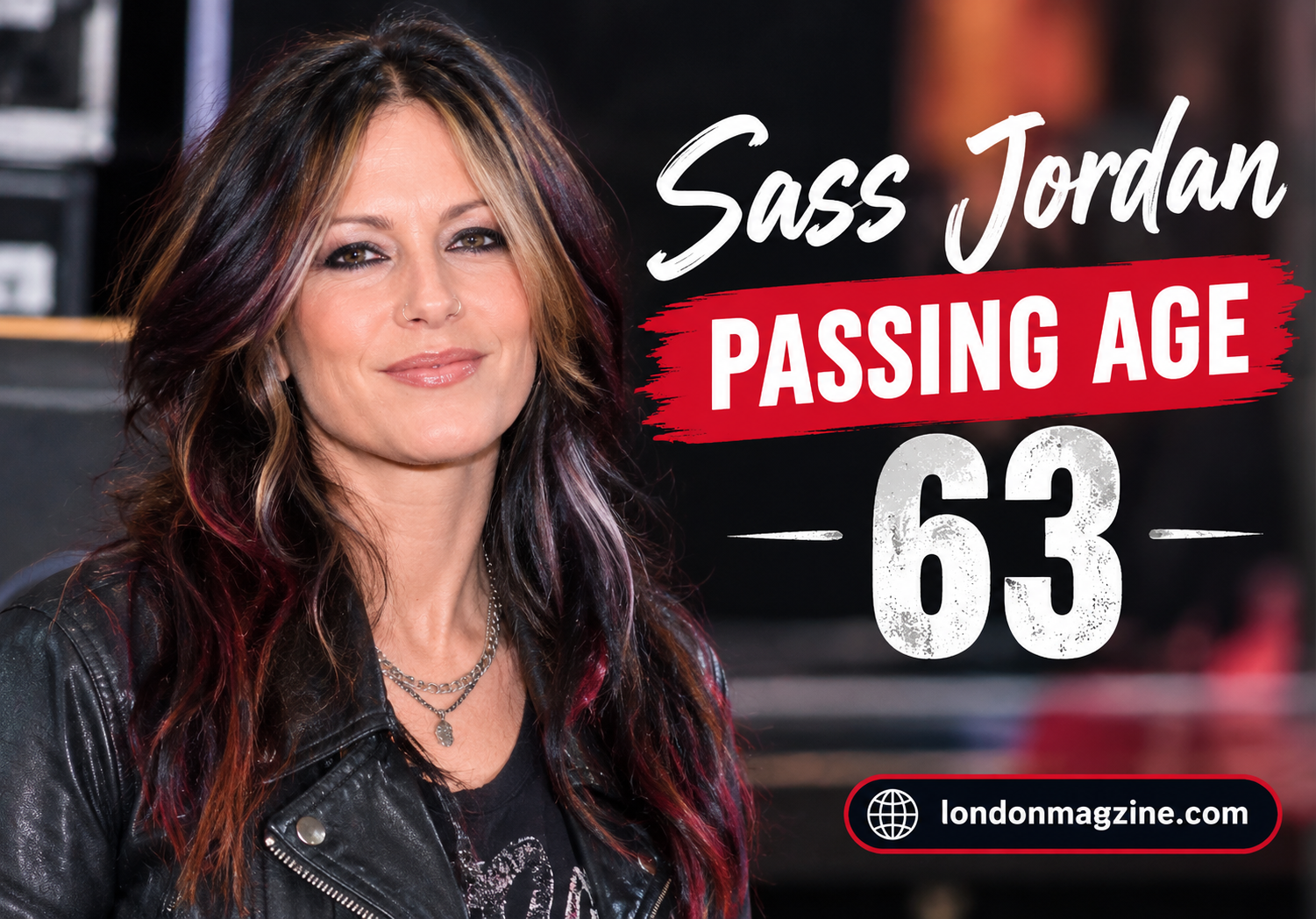
The search phrase “sass jordan passing age 63” has attracted significant attention following the death of Canadian rock singer Sass Jordan in October 2026. But there is an important detail many early reports got wrong: while numerous outlets initially reported that Jordan was 63, her family spokesperson later confirmed that she was 65. That correction makes her final chapter—and the extraordinary career behind it—even more worth remembering.
What Is Sass Jordan Passing Age 63 About?
Sass Jordan was a British-born Canadian rock and blues singer whose career stretched across more than four decades. She became known for her gritty voice, energetic performances, songwriting, and ability to move naturally between hard rock, blues, television, and musical theatre.
Jordan died on October 2, 2026, surrounded by family. Her death was announced through a statement shared by her family, which remembered her as an “inimitable force of nature” and an irreplaceable presence of light and joy.
The immediate confusion surrounding her age came from inconsistent reports. Several publications initially stated that Jordan was 63 and listed her birth year as 1962. However, a later statement from family spokesperson Eric Alper gave her birth date as December 23, 1960, making her 65 when she died.
That distinction is important for anyone searching specifically for “sass jordan passing age 63.” The phrase reflects widely circulated early reporting, but the more recent correction supports an age of 65.
The Story Behind Sass Jordan’s Passing
Her Final Months
Jordan’s death came after her team announced in September 2026 that she would step away from professional commitments because of a serious medical condition.
Several scheduled performances were cancelled, including dates planned for the remainder of the year. Her team said she needed to focus on her health and recovery.
The specific medical condition was not publicly identified. Likewise, her family did not disclose a confirmed cause of death, so claims online about a particular illness or diagnosis should not be treated as established fact.
Jordan ultimately died on October 2, with her family around her.
The timing was especially poignant because she had remained professionally active well into 2026. Rather than quietly disappearing from the music scene, she was still performing and creating music during the later years of her life.
Early Life and Musical Background
Sass Jordan was born Sarah Jordan in Birmingham, England, and moved to Montreal with her family when she was a young child. Montreal became the place where her musical identity developed.
She began performing as a teenager and became involved in the city’s vibrant rock scene. Her early years were marked by experimentation, live performances, and work with other musicians before she established herself as a solo artist.
Jordan’s musical style was difficult to place inside a single box. Rock was central to her career, but blues, soul, and roots music were equally important to her sound.
That mixture eventually became one of her greatest strengths.
From Montreal Clubs to the Recording Studio
Jordan’s recording career began in the 1980s, including work as a vocalist before the release of her solo material.
Her breakthrough arrived with Tell Somebody, released in 1988. The album established her as one of Canada’s most distinctive female rock voices and helped lead to a major industry honor.
In 1989, Jordan won the Juno Award for Most Promising Female Vocalist of the Year.
That recognition opened the door to a much larger career.
Career, Albums and Major Achievements
Racine Changed Everything
If Tell Somebody introduced Sass Jordan to a wider audience, Racine turned her into a major Canadian rock presence.
Released in 1992, Racine produced several successful Canadian singles, including “Make You a Believer.” The album became one of the defining releases of her career and helped establish her reputation beyond Canada.
Jordan also reached an international audience through collaborations and touring.
One particularly memorable achievement was her work with Joe Cocker on “Trust in Me,” which appeared on The Bodyguard soundtrack. The association placed Jordan’s voice alongside one of rock and soul’s most recognizable performers.
Touring With Rock Legends
Jordan’s reputation was not built only through recordings. She also became known as a powerful live performer.
Over the years, she toured alongside major acts including:
- Aerosmith
- The Rolling Stones
- AC/DC
- Van Halen
These experiences helped cement her status as a serious rock performer rather than simply a successful recording artist.
Her career also became connected to an important future rock figure: drummer Taylor Hawkins played in Jordan’s band during the 1994 period associated with the Rats tour.
A later release, Live in New York Ninety-Four, revisited that era and offered listeners another glimpse into Jordan’s live sound.
Sass Jordan and Canadian Idol
For many television viewers, Sass Jordan was introduced through Canadian Idol.
She became a judge when the show premiered in 2003 and remained part of the judging panel throughout its six-season run, which lasted until 2008.
The television role revealed another side of Jordan.
Onstage, she was a fierce rock performer. At the judging table, she could be direct, humorous, emotional, and encouraging. Her experience as a working musician gave her a different perspective from simply evaluating singers as a television personality.
Her position was also significant because she was the only woman on the judging panel throughout the show’s run.
For a new generation of Canadian performers, Jordan was therefore not just a famous singer. She was also someone who had navigated the professional music industry and could speak from experience.
A Career That Kept Evolving
One of the most interesting things about Jordan’s career is that she never stayed locked into the sound that first made her famous.
She continued releasing music and gradually moved further toward the blues.
Her 2020 album Rebel Moon Blues reflected that direction, followed by Bitches Blues in 2022. Rebel Moon Blues also performed strongly on the Billboard Blues Albums chart.
That later period demonstrated something important about Jordan’s artistic identity: she was not simply revisiting her past.
She was continuing to explore it.
The blues elements that had existed underneath her rock career became increasingly visible as she grew older, giving her later recordings a more mature and roots-oriented character.
Why Is “Sass Jordan Passing Age 63” So Popular?
The keyword is particularly interesting because it combines a major celebrity death search with an age discrepancy.
When news of Jordan’s death first spread, multiple outlets reported that she was 63 and gave her birth year as 1962. That version quickly circulated across search engines and social media.
Later, however, Canadian Press reporting based on a statement from family spokesperson Eric Alper corrected the information, saying Jordan was 65 and was born on December 23, 1960.
63 or 65? The Timeline Explains the Confusion
| Detail | Earlier Reports | Later Family Confirmation |
|---|---|---|
| Reported age at death | 63 | 65 |
| Reported birth year | 1962 | 1960 |
| Date of death | October 2, 2026 | October 2, 2026 |
| Place of birth | Birmingham, England | Birmingham, England |
| Cause of death | Not disclosed | Not disclosed |
| Final year activity | Performances planned | Performances cancelled after medical condition |
This is why readers searching for sass jordan passing age 63 may encounter apparently conflicting information.
The 63 figure was not simply invented by search users. It appeared in multiple early news reports. But subsequent reporting carried a correction from her family representative, making 65 the more recently confirmed age.
Her Legacy Goes Beyond One Hit
It would be easy to remember Sass Jordan only for “Make You a Believer” or her time on Canadian Idol.
Her career was much broader.
She was part of a generation of women who built substantial careers in rock music at a time when the genre was often heavily dominated by male performers. Her powerful vocal style and fearless stage presence helped demonstrate that female rock artists could command the same space and intensity as their male counterparts.
Her influence also extended through the musicians who worked with her.
Jordan’s connection to Taylor Hawkins is one example that has received renewed attention after her death. Her willingness to work with younger musicians became part of the wider story of her career.
She also continued to make records long after her early commercial peak, proving that her relationship with music was not dependent solely on chart success.
Facts at a Glance
| Category | Details |
|---|---|
| Full name | Sarah “Sass” Jordan |
| Born | December 23, 1960, according to later family confirmation |
| Birthplace | Birmingham, England |
| Raised in | Montreal, Quebec |
| Died | October 2, 2026 |
| Age at death | 65 |
| Profession | Singer, songwriter, actress, television personality |
| Best known for | “Make You a Believer,” Racine, Canadian Idol |
| Major award | 1989 Juno Award |
| TV role | Judge on all six seasons of Canadian Idol |
| Final studio era | Rebel Moon Blues and Bitches Blues |
Frequently Asked Questions
Was Sass Jordan really 63 when she died?
No. Although many early reports said Sass Jordan was 63, a later statement from family spokesperson Eric Alper confirmed that she was born on December 23, 1960. Since she died on October 2, 2026, that would make her 65. The 63 figure came from earlier reporting that listed her birth year as 1962.
When did Sass Jordan pass away?
Sass Jordan died on October 2, 2026, surrounded by her family. Her family announced the news publicly and remembered her as an extraordinary and joyful presence. Her death followed the cancellation of her remaining 2026 performances after she was reported to be dealing with a serious medical condition.
What was Sass Jordan best known for?
Jordan was best known for her successful Canadian rock career, particularly the album Racine and the song “Make You a Believer.” She was also widely recognized as a judge on all six seasons of Canadian Idol. Her collaborations, touring career, blues recordings, and live performances added further depth to her legacy.
What was the cause of Sass Jordan’s death?
A specific cause of death had not been publicly disclosed in the available family and Canadian news reports. Her team had previously announced that she was dealing with a serious medical condition and cancelled her remaining 2026 performances. It is therefore important not to treat unconfirmed online claims about a specific illness as fact.
Who survived Sass Jordan?
Jordan was survived by her husband, Derek Sharp, her daughter Stella Jordan-Sharp, her stepdaughter Brianne Sharp, and her brother Daniel Jordan. Her family asked for privacy while grieving and expressed gratitude for the support and affection shown by fans.
Conclusion
The phrase sass jordan passing age 63 reflects a genuine wave of early reporting following the singer’s death, but the later family-confirmed information points to 65. Beyond the age discrepancy, Sass Jordan leaves behind a remarkable musical story: from Montreal’s rock scene to Juno recognition, international touring, Canadian Idol, and a later embrace of the blues. Her voice—and the space she created for women in rock—will remain central to her legacy.












Leave a Reply