
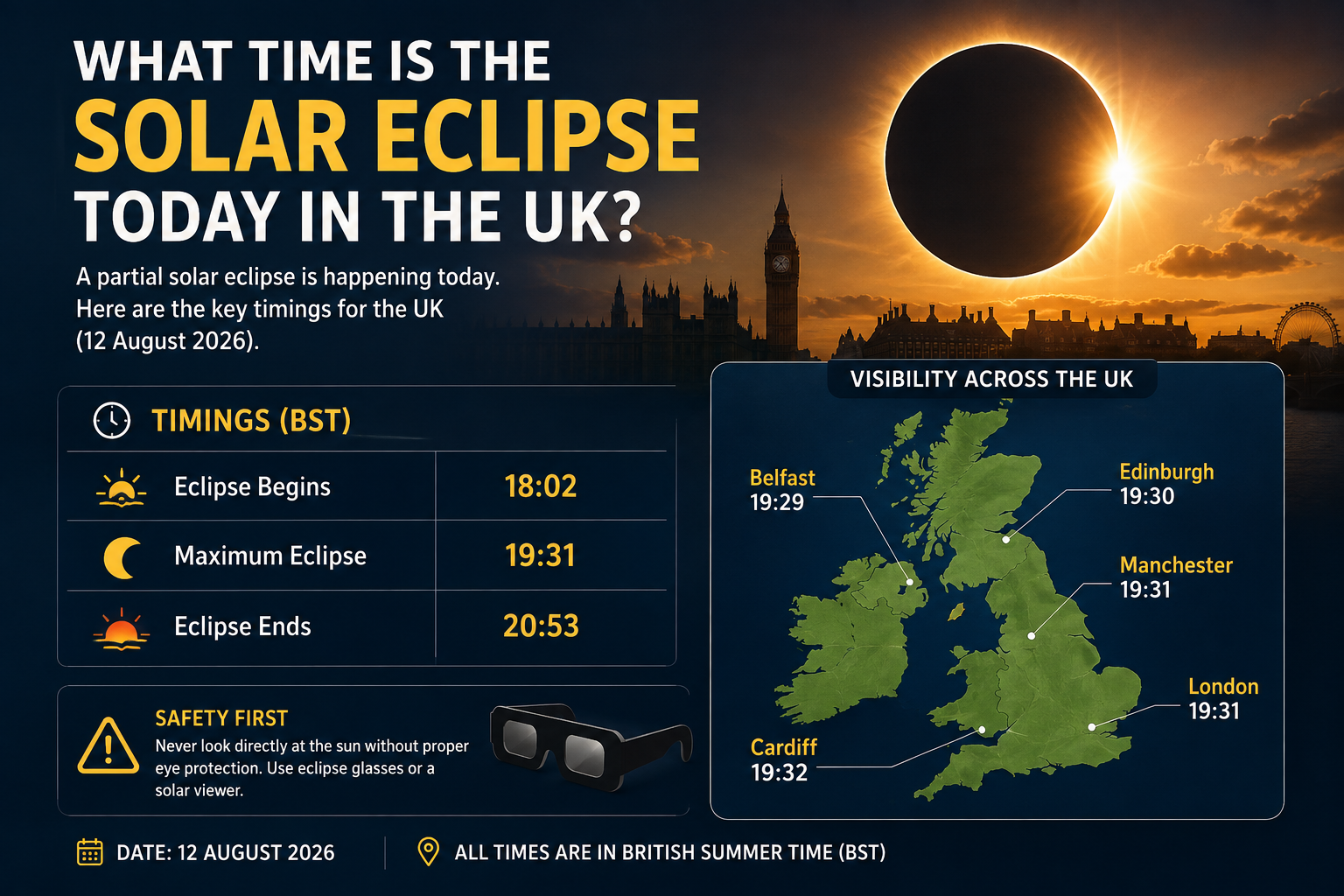
Set an alarm, clear your evening, and maybe cancel dinner plans — because today, Wednesday 12 August 2026, the UK is about to witness something most of us have never seen in our lifetimes. A deep partial solar eclipse is sweeping across Britain and Ireland this evening, and astronomers are calling it the best eclipse the country has had since 1999. That’s not hype. That’s just math.
So let’s get straight to what you actually came here for: what time does it happen, and where should you be standing?
The Timeline, Hour by Hour
The eclipse doesn’t arrive all at once — it builds slowly, like a tide coming in. In London, first contact (the moment the Moon first touches the edge of the Sun) happens at around 6:17pm. From there, the Moon creeps across the Sun’s face for the better part of an hour, and things start getting genuinely dramatic as we approach 7pm.
Maximum eclipse — the peak moment, when the Moon covers the most of the Sun it’s going to — lands somewhere between 7:06pm and 7:13pm BST, depending on your exact location. Out in Essex, astronomers at the Loughton Astronomical Society have it pegged even more precisely: eclipse begins at 18:17, peaks at 19:13, and wraps up by around 20:06. Close enough to the London figures that you don’t need to stress over the exact minute — just make sure you’re outside and looking west by 6:45pm at the latest.
By 8pm, it’s essentially over. The Moon has moved on, the Sun’s back to its normal blazing self, and the whole thing will feel like it lasted longer than it actually did.
How Much of the Sun Will Actually Disappear?
Here’s where it gets interesting, and where I think a lot of people get the wrong idea. This is not a total eclipse. The sky isn’t going to go pitch black, and you won’t see stars come out at 7pm. For that kind of spectacle, you’d need to be in Greenland, Iceland, or northern Spain, where the Moon’s shadow actually creates a full path of totality.
What Britain and Ireland get instead is a deep partial eclipse — somewhere between 90 and 96 percent of the Sun blocked out, depending on where you are. And that range matters more than you’d think. Cardiff, sitting closest to the path of totality, gets the deepest coverage of any major UK city, narrowly beating Belfast. The Isles of Scilly and Cornwall, tucked into the southwest, see close to 96 percent — about as good as it gets without leaving British soil. Head northeast and the numbers drop off a bit, though even the least dramatic parts of the UK are still looking at somewhere around 88 to 90 percent.
For context: the last time anywhere in Britain saw coverage this deep was back in March 2015, when parts of Scotland hit 98 percent while the actual total eclipse swept over the Faroe Islands and Svalbard. Before that, you’re going back to 1999. So yes, “once in a generation” isn’t just marketing copy here — it’s genuinely rare.
Why the Sun’s Position Makes This Tricky
This is the part most casual eclipse-watchers don’t think about until it’s too late: today’s eclipse happens uncomfortably close to sunset. The Sun will already be well on its way down toward the horizon by the time maximum eclipse rolls around, which changes how — and where — you should be watching from.
In Dover, for instance, the Sun sits only about 9 degrees above the horizon at peak eclipse. That’s low. Genuinely low. Further northwest, somewhere like Cumbria, you get a bit more altitude to work with — around 13 degrees, with the Sun staying visible for roughly 50 minutes after maximum before it finally dips below the horizon around sunset.
What does this mean practically? Forget your back garden if it’s hemmed in by trees or houses to the west. You need a proper, unobstructed view toward the west or west-northwest — think elevated ground, open coastline, or a rooftop with a clear sightline. And here’s a tip that’s easy to overlook: scout your spot the evening before, at roughly the same time, just to check the Sun’s actually visible from there. A stray hill, a line of trees, even a thin band of haze on the horizon can completely ruin the view, even if the sky directly overhead looks perfectly clear.
In London specifically, Primrose Hill is shaping up to be one of the most popular viewing spots — elevated, open, and with a skyline view that takes in the Shard, St Paul’s Cathedral, and the Gherkin as a backdrop. Expect it to be busy. Get there early if you want a decent patch of grass.
The Weather Question
Nobody can guarantee clear skies, obviously, but the forecast for London today is looking promising — mostly sunny, with temperatures around 74°F (23°C). That said, London’s historical cloud cover on this date sits at around 78 percent going back to the year 2000, so don’t get too complacent. Keep an eye on your local forecast throughout the afternoon, and if your chosen spot clouds over, have a backup location in mind.
Eye Safety — Please, Actually Read This Part
I know eclipse safety warnings can feel like the boring bit everyone skips past, but this one genuinely matters. Never look directly at the Sun during a partial eclipse without certified eclipse glasses — and I mean never, not even for a second, not even when it looks mostly covered. Regular sunglasses do nothing to protect your eyes here; the Sun’s rays can cause serious, permanent retinal damage even when 90-plus percent of the disc is blocked. The worst part? You often won’t feel any pain while it’s happening. The damage shows up later, once it’s too late to undo.
If you don’t have certified eclipse glasses, don’t try to improvise with camera film, smoked glass, or multiple pairs of sunglasses stacked together — none of it works reliably, and it’s not worth the risk to your eyesight for a photo.
What Comes Next
If you miss this one, the wait is a long one. The next total solar eclipse visible from the UK isn’t due until 2090. Even a partial eclipse coming close to this level of drama has to wait until 2081, when up to 99 percent coverage is expected. In between, there are smaller partial eclipses scattered through 2030, 2053, 2066, 2075, and 2082 — but nothing that touches today’s numbers.
And if tonight leaves you wanting more, mark your calendar for 28 August. Just two weeks after this solar eclipse, a 90 percent partial lunar eclipse will be visible from the UK — eclipses, as it turns out, tend to travel in pairs.
So that’s the full picture. Grab your eclipse glasses, find a spot with a clear western view, and be outside by 6:45pm. Maximum eclipse hits around 7:10pm — and if the skies cooperate, you’re about to see something this country won’t see again for decades.





Leave a Reply